As Europe prepares for the next phase of tobacco and nicotine regulation, one principle should sit at the heart of any evidence-based discussion:
Before we can understand risk, behaviour, or public health impact, we need to understand what is actually being measured.
It sounds obvious.
Yet a recent correction issued by Eurostat, the European Union’s official statistical authority, demonstrates how easily distinctions between very different nicotine products can quickly – and concerningly – become blurred.[i]
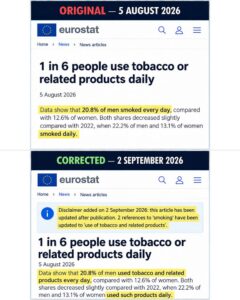
In August 2026, Eurostat published data relating to the daily use of tobacco and related products. While the underlying dataset combined cigarettes, vapes, nicotine pouches, heated tobacco products, and other categories, references within the accompanying article described the resulting figures as “smoking” – even for products such as nicotine pouches where no inhalation is involved at all.
Following correspondence from Imperial Brands, the wording was subsequently corrected.[ii]
On the surface, this may appear to be a minor issue of terminology.
However, when distinctions this important become opaque within an official European statistical publication, it raises wider questions about how nicotine product categories are understood, discussed, and ultimately regulated.
Different Products, Different Outcomes
Cigarettes, vapes, heated tobacco, and oral nicotine pouches are not the same products.
They involve different technologies, different patterns of use and behaviours, different routes of nicotine delivery, and different scientific evidence bases.
Combining those categories may be useful when examining overall nicotine and tobacco-related product use. However, doing so makes it much harder to understand what’s happening beneath the headline figures.
If an adult smoker completely switches from cigarettes to a non-combustible product, smoking prevalence has fundamentally changed from a public health perspective. A combined metric doesn’t reveal that.
Similarly, if policymakers want to understand switching behaviours away from smoking, category adoption, or the broader impact of tobacco harm reduction, product-specific evidence becomes essential.
Without those distinctions, potentially crucial trends become invisible.
Most importantly, while vapes, heated systems, and oral nicotine pouches differ from one another in some respects, they are all fundamentally different from cigarettes.
The weight of scientific evidence suggests all these smoke-free product categories expose users to substantially fewer and lower levels of harmful chemicals than cigarette smoke; consequently they possess markedly reduced risk profiles compared with continued smoking.
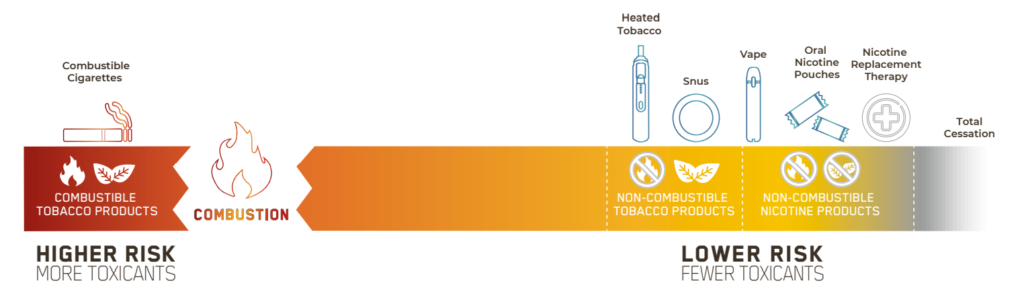
At a time when discussions around cigarettes, nicotine, and smoke-free alternatives are increasingly shaping major regulatory decisions likely to have a significant impact on future public health, the ability to clearly distinguish between combustible and non-combustible products has never been more important.
When those key distinctions are lost in the reporting of the data, they also potentially disappear from the wider public conversation.
An Error That Outlived the Correction
The consequences of imprecise terminology do not necessarily end when the original source is corrected.
This was also true in the Eurostat case, even following their amendment.
A subsequent independent Euronews article continued referring to the figures as “smoking prevalence”, despite acknowledging the underlying dataset covered tobacco and related products more broadly.[iii]
Whether this resulted directly from the original wording, or a separate interpretation of the data, is ultimately secondary.
The point is that once inaccurate terminology enters public discourse, it has the potential to continue shaping stakeholder understanding and fostering misconceptions (already rife in the case of cigarettes, nicotine, and smoke-free products) long after the original source has been amended.
This is precisely why clear definitions and accurate classification matter.
Scientific discussions become significantly more difficult when stakeholders are no longer talking about the same thing.
A Critical Moment for Europe
This discussion arrives at a particularly important time.
The European Commission’s DG SANTE is currently preparing to revise the Tobacco Products Directive (TPD). As regulators like the EU consider future frameworks for nicotine products, robust evidence and accurate classification will be more important than ever.
For example, proposals to extend cigarette-style pictorial health warnings on plain packaging to vapes, heated products or nicotine pouches raise questions about what people understand from those measures. Assessment should examine whether the messages accurately communicate the risk of the relevant products, how they affect perfections of risk relative to smoking, and their effects on switching behaviour.
Reporting all these products use as smoking cannot answer those questions.
At a time when regulatory decisions increasingly depend on large datasets and population-level evidence, accurate classification becomes more important, not less.
While regulatory frameworks for NGP inevitably differ, these developments demonstrate that rigorous regulatory oversight and recognition of relative risk can coexist.
This does not mean abandoning caution.
It means applying caution appropriately.
Evidence Before Assumptions
Eurostat’s error, and subsequent correction, illustrates a fundamental point.
Before policymakers can evaluate risks, benefits, behavioural change, or public health outcomes, they need clarity around precisely what is being measured. Indeed, the European Commission has an obligation to base decisions on scientific facts under its founding treaties.
Public health discussions become far more productive when assumptions are replaced with evidence, and when combustible and non-combustible categories are distinguished rather than conflated.
As Europe enters the next chapter of tobacco and nicotine regulation, ensuring those distinctions remain visible is vital. Without them, regulators, researchers, public health stakeholders, and consumers alike risk losing sight of the very evidence needed to inform better decisions and improve public health outcomes.
Read our response to the European Commission JRC Report here.
[i] Eurostat Original Publication (5 August 2026)
Archived version of the original Eurostat article referring to combined tobacco and related product use figures as smoking.
https://web.archive.org/web/20260805220206/https://ec.europa.eu/eurostat/web/products-eurostat-news/w/ddn-20260805-1
[ii] Eurostat Corrected Publication (26 August / 2 September 2026)
Archived corrected version and current publication carrying the amendment and correction notice.
https://web.archive.org/web/20260826132946/https://ec.europa.eu/eurostat/web/products-eurostat-news/w/ddn-20260805-1
https://ec.europa.eu/eurostat/web/products-eurostat-news/w/ddn-20260805-1
[iii] Euronews Coverage (1 September 2026, updated 6 September 2026)
https://www.euronews.com/my-europe/2026/09/01/cigarettes-are-on-the-decline-in-the-eu-but-how-popular-are-smoking-and-vaping-still
Follow us on LinkedIn and read more about our intentions to help create potentially healthier futures for our consumers on our corporate website. You are free to share this content with credit to Imperial Brands under a Creative Commons Attribution-NoDerivatives 4.0 International (CC BY-ND 4.0) license.