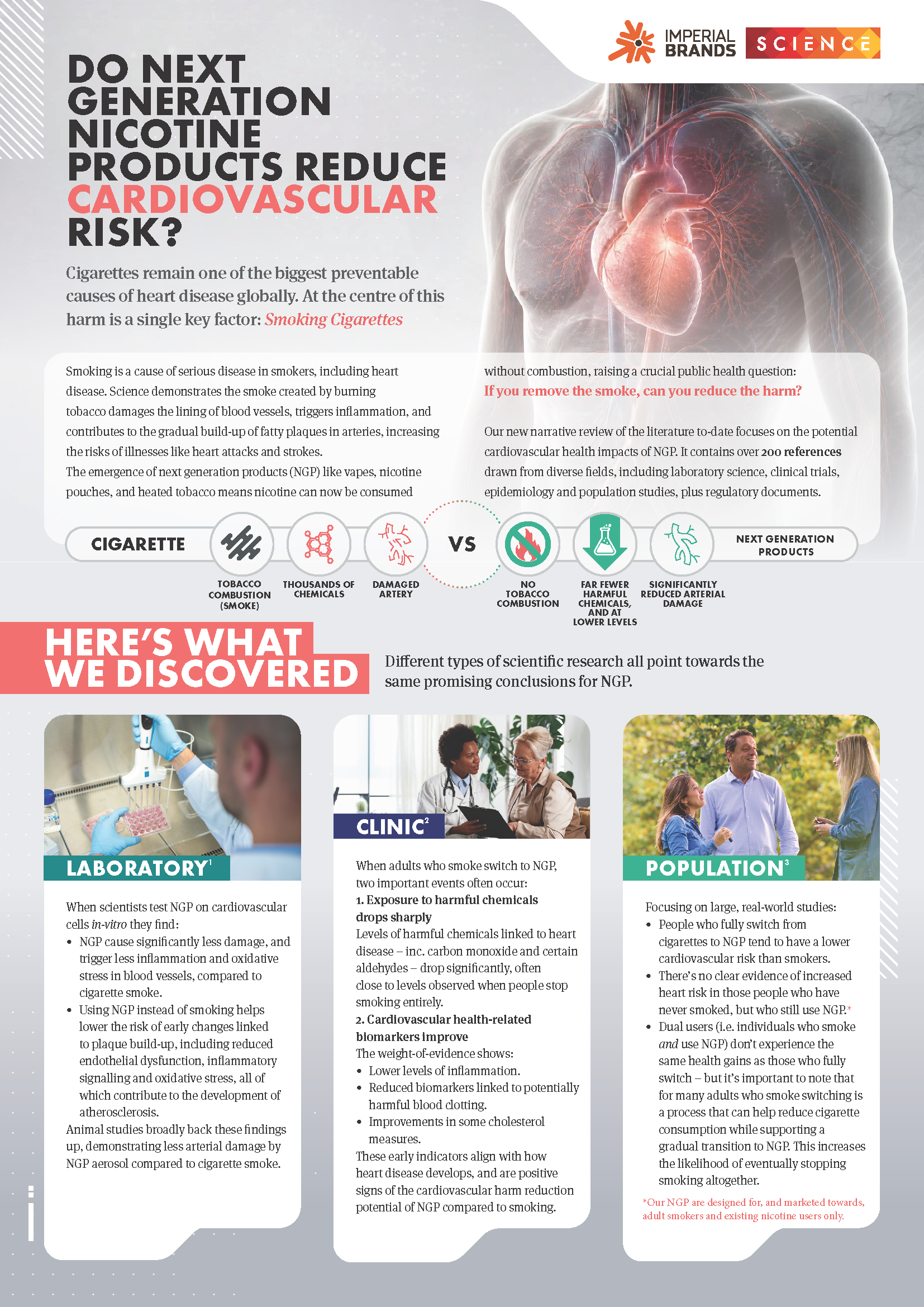
Cigarettes remain one of the biggest preventable causes of heart disease globally. At the centre of this harm is a single key factor: smoking cigarettes.
Smoking is a cause of serious disease in smokers, including heart disease. Science demonstrates the smoke created by burning tobacco damages the lining of blood vessels, triggers inflammation, and contributes to the gradual build-up of fatty plaques in arteries, increasing the risks of illnesses like heart attacks and strokes.
The emergence of next generation products (NGP) like vapes, nicotine pouches, and heated tobacco means nicotine can now be consumed without combustion, raising a crucial public health question:
If you remove the smoke, can you reduce the harm?
Our new comprehensive narrative review of the literature focuses on the potential cardiovascular health impacts of NGP. This review contains over 200 references drawn from diverse fields, including laboratory science, clinical trials, epidemiology and population studies, plus regulatory documents.
The good news is that different types of research point towards the same promising conclusions for NGP.
 In the Lab…[i]
When scientists test NGP on cardiovascular cells (in-vitro) they find:
Animal studies broadly back these findings up, demonstrating less arterial damage by NGP aerosol compared to cigarette smoke.
In the Clinic…[ii]
When adults who smoke switch to NGP, two important events often occur:

These are admittedly early indicators, but they closely align with what we know about how heart disease develops, and are therefore positive signs of the cardiovascular harm reduction potential of NGP compared to smoking.
 In Wider Populations…[iii]
Focusing on large, real-world studies:
*Our NGP and made for, and marketed towards, adult smokers and existing nicotine consumers only.
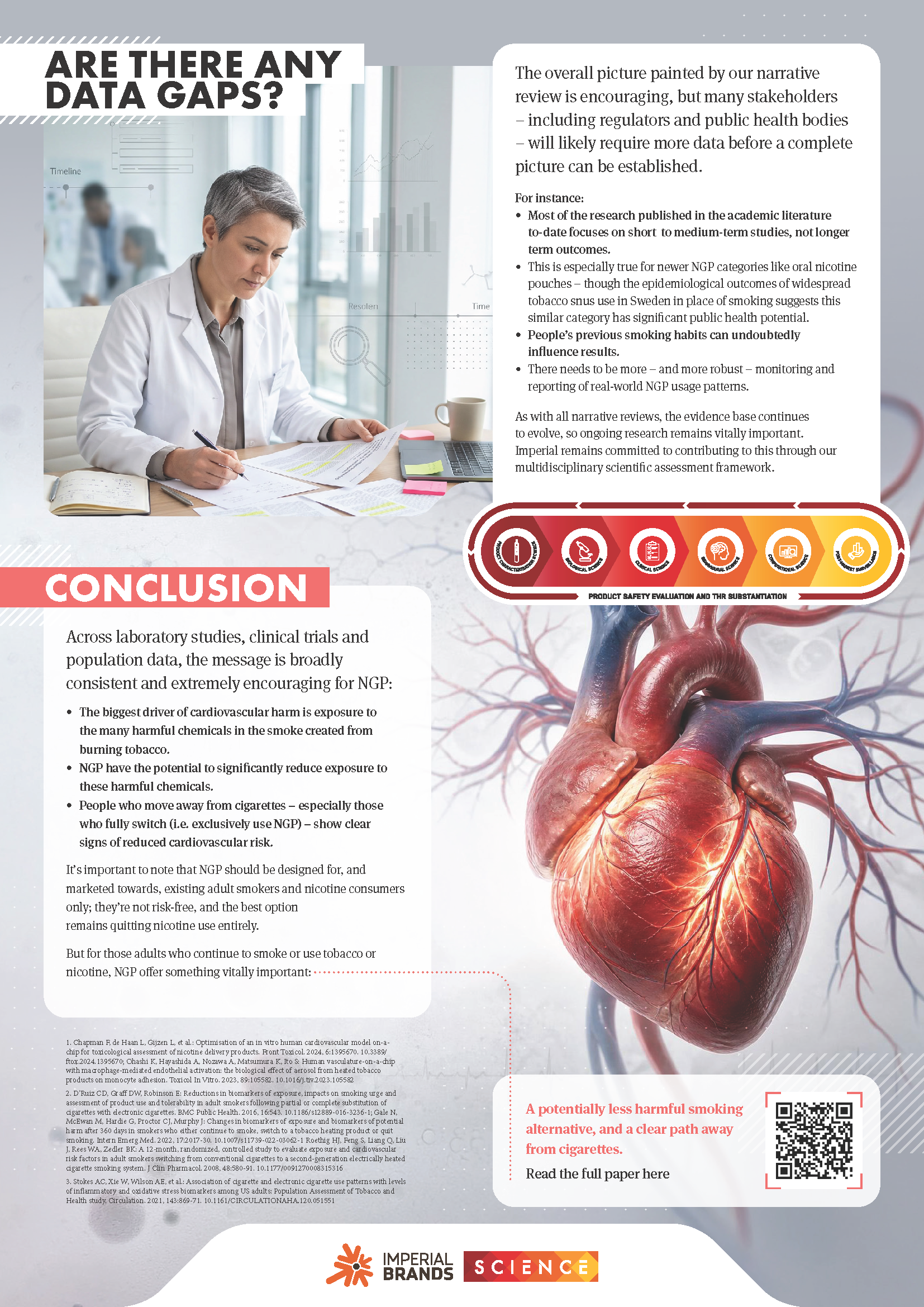
Are there any Data Gaps?
The overall picture painted by our narrative review is encouraging, but many stakeholders – including regulators and public health bodies – will likely require more data before a complete picture can be established.
For instance:
People’s previous smoking habits can undoubtedly influence results
There needs to be more, and more robust, monitoring and reporting of real-world NGP usage patterns.
As with all narrative reviews, the evidence base continues to evolve, and ongoing research remains vitally important – which Imperial remains committed to contributing to through our multidisciplinary scientific assessment framework.
Across laboratory studies, clinical trials and population data, the message is broadly consistent and extremely encouraging for NGP:
It’s important to note that NGP should be designed for, and marketed towards, existing adults who smoke and nicotine consumers only; they’re not risk-free, and the best option remains quitting tobacco and nicotine entirely.
But for adults who continue to smoke, NGP offer something vitally important:
A potentially less harmful smoking alternative, and a path away from cigarettes.
Download the above infographic here.
Written by Rob Taylor, Senior Harm Reduction Communications Manager.
Sources
[i] Chapman F, de Haan L, Gijzen L, et al.: Optimisation of an in vitro human cardiovascular model on-a-chip for toxicological assessment of nicotine delivery products. Front Toxicol. 2024, 6:1395670. 10.3389/ftox.2024.1395670;
Ohashi K, Hayashida A, Nozawa A, Matsumura K, Ito S: Human vasculature-on-a-chip with macrophage-mediated endothelial activation: the biological effect of aerosol from heated tobacco products on monocyte adhesion. Toxicol In Vitro. 2023, 89:105582. 10.1016/j.tiv.2023.105582
[ii] D’Ruiz CD, Graff DW, Robinson E: Reductions in biomarkers of exposure, impacts on smoking urge and assessment of product use and tolerability in adult smokers following partial or complete substitution of cigarettes with electronic cigarettes. BMC Public Health. 2016, 16:543. 10.1186/s12889-016-3236-1;
Gale N, McEwan M, Hardie G, Proctor CJ, Murphy J: Changes in biomarkers of exposure and biomarkers of potential harm after 360 days in smokers who either continue to smoke, switch to a tobacco heating product or quit smoking. Intern Emerg Med. 2022, 17:2017-30. 10.1007/s11739-022-03062-1
Roethig HJ, Feng S, Liang Q, Liu J, Rees WA, Zedler BK: A 12-month, randomized, controlled study to evaluate exposure and cardiovascular risk factors in adult smokers switching from conventional cigarettes to a second-generation electrically heated cigarette smoking system. J Clin Pharmacol. 2008, 48:580-91. 10.1177/0091270008315316
[iii] Stokes AC, Xie W, Wilson AE, et al.: Association of cigarette and electronic cigarette use patterns with levels of inflammatory and oxidative stress biomarkers among US adults: Population Assessment of Tobacco and Health study. Circulation. 2021, 143:869-71. 10.1161/CIRCULATIONAHA.120.051551
Follow us on LinkedIn and read more about our intentions to help create potentially healthier futures for our consumers on our corporate website. You are free to share this content with credit to Imperial Brands under a Creative Commons Attribution-NoDerivatives 4.0 International (CC BY-ND 4.0) license.