Over the last decade, the scientific assessment of smokeless products has evolved dramatically.
Researchers can now draw upon chemistry, toxicology, clinical science, behavioural research, and real-world evidence to better understand how these products compare with cigarettes.
Together – as our own Scientific Assessment Framework demonstrates – these disciplines provide valuable insights into product performance and consumer behaviour.
They also present a compelling weight-of-evidence approach to the harm reduction potential of smokeless products compared to cigarettes.
While traditional scientific methods help us understand what has already happened, public health decisions are often made before longer-term outcomes are fully visible.
Policymakers cannot always wait decades to understand the consequences of today’s regulatory choices.
This is where computational science may become increasingly important.
Understanding What Happens Next
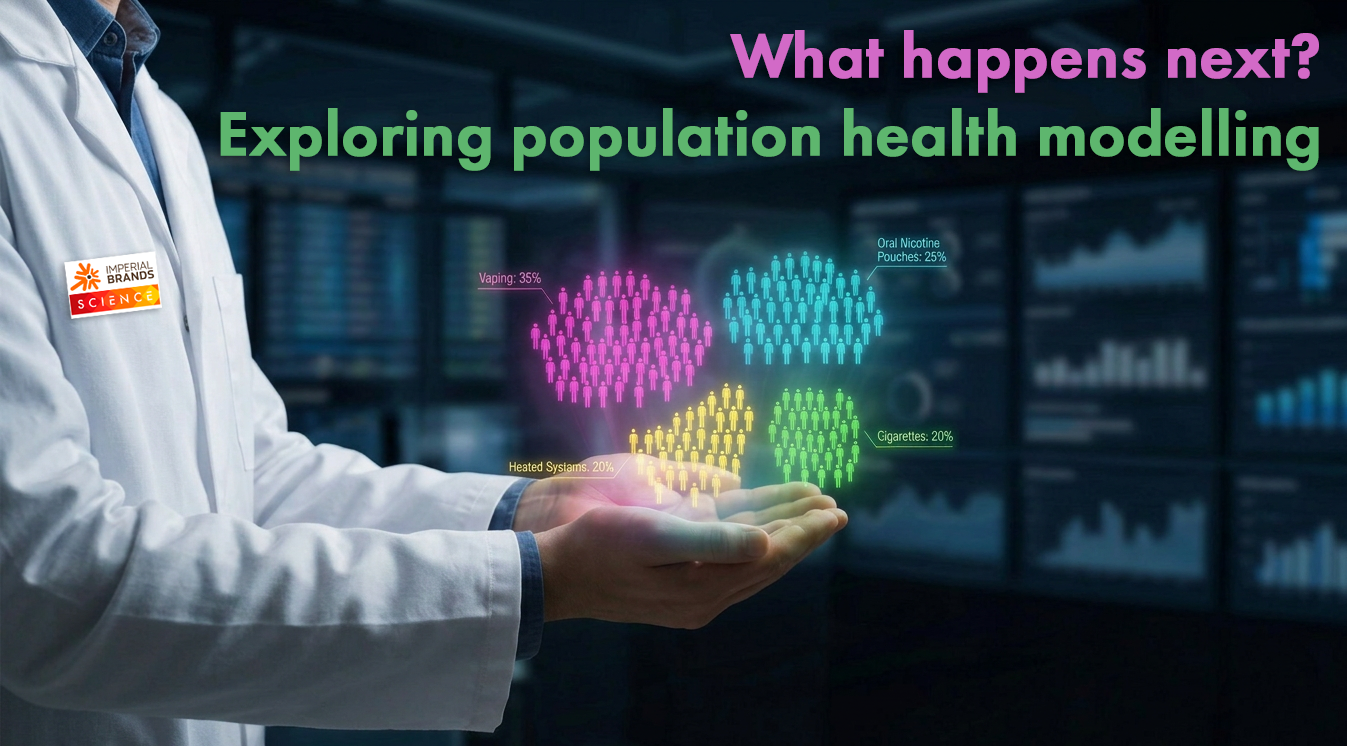
Computational science complements more traditional forms of scientific assessment by helping researchers explore how populations may respond to different scenarios using mathematical modelling, behavioural data, demographic trends, and disease risk estimates.
Rather than replacing laboratory, clinical, or behavioural research, it helps build on those insights by asking a crucial question: “what happens next?”
For example:
These questions are difficult to answer through traditional research alone.
Computational models provide a way to explore potential future outcomes and identify patterns that may otherwise remain hidden.
A New Approach to Population Modelling
Imperial Brands scientists have recently contributed to this field through the publication of a peer-reviewed paper:
An Innovative Time Series Approach to Dynamic Population Modelling for Tobacco Harm Reduction Assessment.
The research introduces an innovative dynamic population modelling methodology designed to explore how changes in consumer behaviour may influence future public health outcomes over time.
By bringing together multiple evidence streams, including prevalence trends and behavioural data, this holistic approach aims to create a more realistic picture of how populations may respond to changing circumstances.
Importantly, the model cannot predict the future with 100% certainty.
Instead, it provides a structured framework for exploring different scenarios and understanding how behavioural changes at an individual level may translate into broader population-level outcomes.
Why It Matters
Public health decisions are rarely made with perfect information.
Regulators, researchers, and policymakers must often make decisions while evidence is still emerging and behaviours continue to evolve.
Computational science provides another important tool to potentially help navigate that uncertainty.
For example, when our newly published model was applied to the UK, it suggested that wider adoption of smokeless alternatives could potentially prevent between 360,000 and 850,000 premature deaths by 2040, with as many as 1.53 million deaths potentially avoided under higher switching scenarios. The largest reductions were associated with smoking-related diseases including lung cancer, cardiovascular disease, and stroke.
Understanding possible future outcomes like these through sophisticated modelling can potentially support evidence-based policymaking.
As smokeless product categories continue to evolve at pace, the ability to evaluate both current evidence and potential future impacts will become increasingly important.
It’s clear that the future of scientific assessment will depend on multiple scientific approaches working in alignment, because for manufacturers, researchers, and regulators alike the challenge is no longer simply understanding what has happened – it’s understanding what may happen next.
Follow us on LinkedIn and read more about our intentions to help create potentially healthier futures for our consumers on our corporate website. You are free to share this content with credit to Imperial Brands under a Creative Commons Attribution-NoDerivatives 4.0 International (CC BY-ND 4.0) license.