By Rory Shadbolt, Scientific Officer
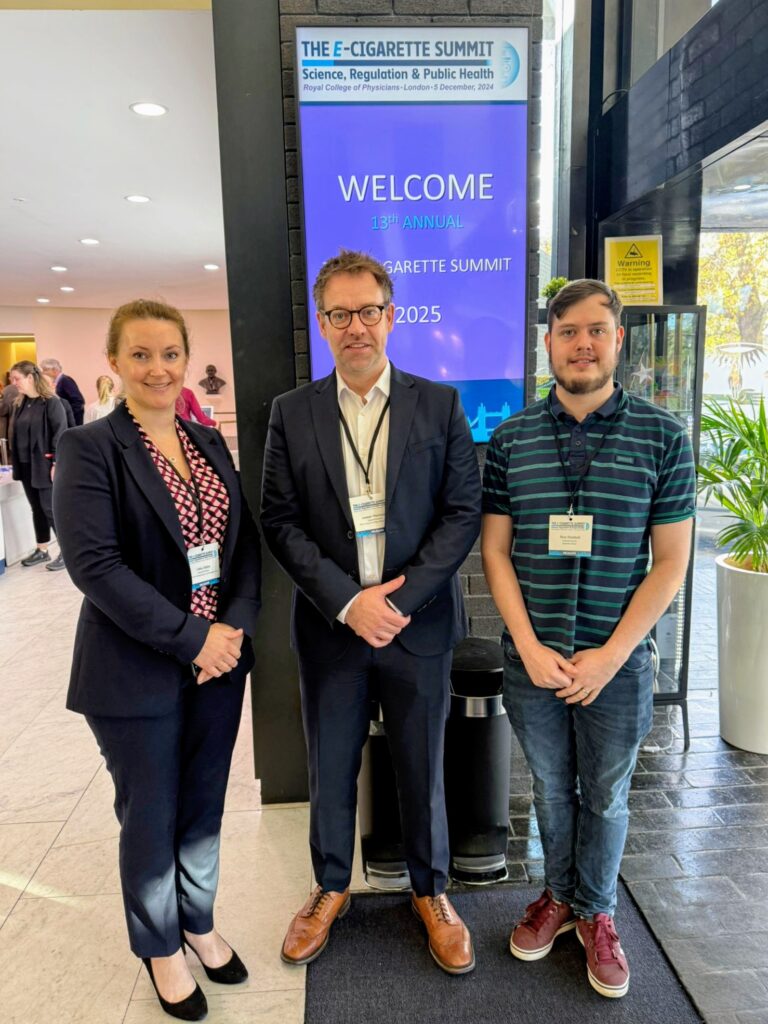
Scientists from Imperial Brands attended the 13th E-Cigarette Summit in London, UK last week.
The focus, naturally, was vaping – with deep dives from a diverse range of independent academics, scientists, and public health advocates into various societal, scientific, and regulatory issues facing the world’s most popular next generation product (NGP) category.
Here are our top 6 takeaways from the conference:
 Despite some successes, tobacco harm reduction remains far from being accepted
Smoking still cuts years from smokers’ lives – with warnings that smoking-related disease may contribute to a billion deaths by the end of the century. Despite many countries planning for Smoke-Free futures, and reducing smoking rates through potentially reduced risk NGP, unfortunately tobacco harm reduction remains a far from universally-accepted concept – and this is undoubtedly hampering public health progress.
 Products are inconsistently regulated between countries
A lack of consensus means global regulatory approaches vary wildly. However, extreme regulation – including flavour bans and unfavourable tax regimes – widens societal inequalities, increases unintended consequences, and decreases smokers’ opportunities to switch to NGP. To quote Professor Johnathan Foulds from Penn State University: “Never [implement] stricter… regulation or product standard[s]… for a less harmful product than for a more harmful product.”
 The opportunity to regulate relative to risk is often overlooked
Many speakers concurred that public health bodies and regulators should treat cigarettes and NGP differently based on their relative harms, ideally using rigorous scientific evidence-based approaches like the continuum of risk. To ignore scientific data in favour of subjective opinions or ideologies is potentially very damaging to public health. See our own relative risk scale here.
 The weight of evidence supporting tobacco harm reduction is growing
Leading researchers from multiple markets presented data reinforcing this view, with recognition that pragmatically regulated vapes are likely to deliver significant public health benefits, even with an accompanying on-ramp by non-smokers (which nevertheless remains a vital issue to safeguard against). However, many public health and regulatory approaches continue to be misaligned with the broader scientific evidence base.
 Myths and misconceptions around NGP continue to severely undermine their public health potential – and misinformation is on the rise
For instance, concerningly a Cancer UK-funded survey revealed only 27% of smokers now believe vaping is ‘safer’ than cigarettes (a fall from 44% in 2014). Clear, consistent, trust-building communication remains essential to building consensus around the public health potential of NGP like vapes. Read more about misconceptions here.
 Illicit NGP are putting tobacco harm reduction – and consumers – at risk
This is especially true in relation to product compliance and links with organised crime. Illegal products undoubtedly have the potential to greatly undermine the public health potential of NGP. However, some governments are recognising this and – in the case of the UK, for instance, increasing support to tackle the issue. Read more about our own approach to illicit NGP here.
The above is clearly just a small selection of the evidence and debate emerging from the summit, but it’s encouraging to see that independent researchers and advocates for public health appear to be increasingly aligned with responsible manufacturers in their broad support for NGP like vapes.
We thank the organisers, chair, and speakers for another enlightening event.
Additional words by Rob Taylor, Senior Harm Reduction Communications Manager.
Follow us on LinkedIn and read more about our intentions to help create potentially healthier futures for our consumers on our corporate website. You are free to share this content with credit to Imperial Brands under a Creative Commons Attribution-NoDerivatives 4.0 International (CC BY-ND 4.0) license.