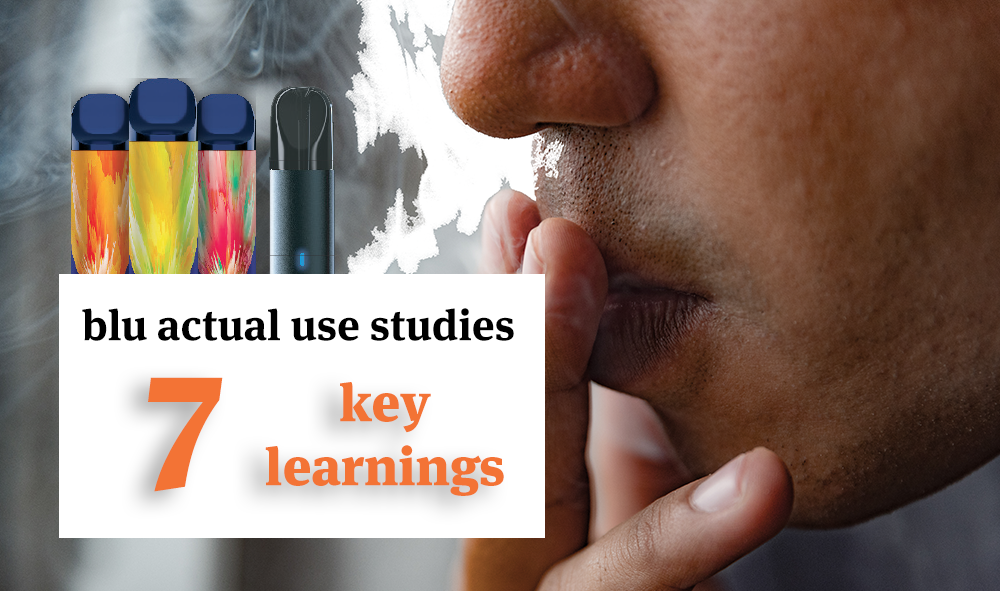
Over the past two years, Imperial Brands has conducted innovative ‘actual use’ behavioural studies.
This close-to-real-world research features real adult smoker participants in real next generation product (NGP) markets.
Why are we doing this?
Well – alongside the vital ‘science for compliance’ required for successful NGP market launches – we’re also keen to substantiate the tobacco harm reduction (THR) potential of our NGP across our scientific assessment framework (SAF).
Some of the research within the SAF is truly novel, and in the case of our actual use studies we believe they’re providing fresh, compelling data demonstrating that our NGP can positively contribute to public health.
For our most recent in-market behavioural research, we focused on vapes in the UK using blu bar and blu 2.0.
We’ve already presented top-line findings here; while blu is not a licensed smoking cessation product, and isn’t marketed as such, the results were nevertheless extremely encouraging in terms of demonstrating vaping’s THR potential.
Now, our scientists are diving more deeply into participants’ individual journeys to better understand what factors are driving behavioural change.
Below are 7 key learnings from the studies.
 Vaping had a near-instant impact on participants’ smoking behaviour; the majority of smoking reduction occurred during the first week of each study.
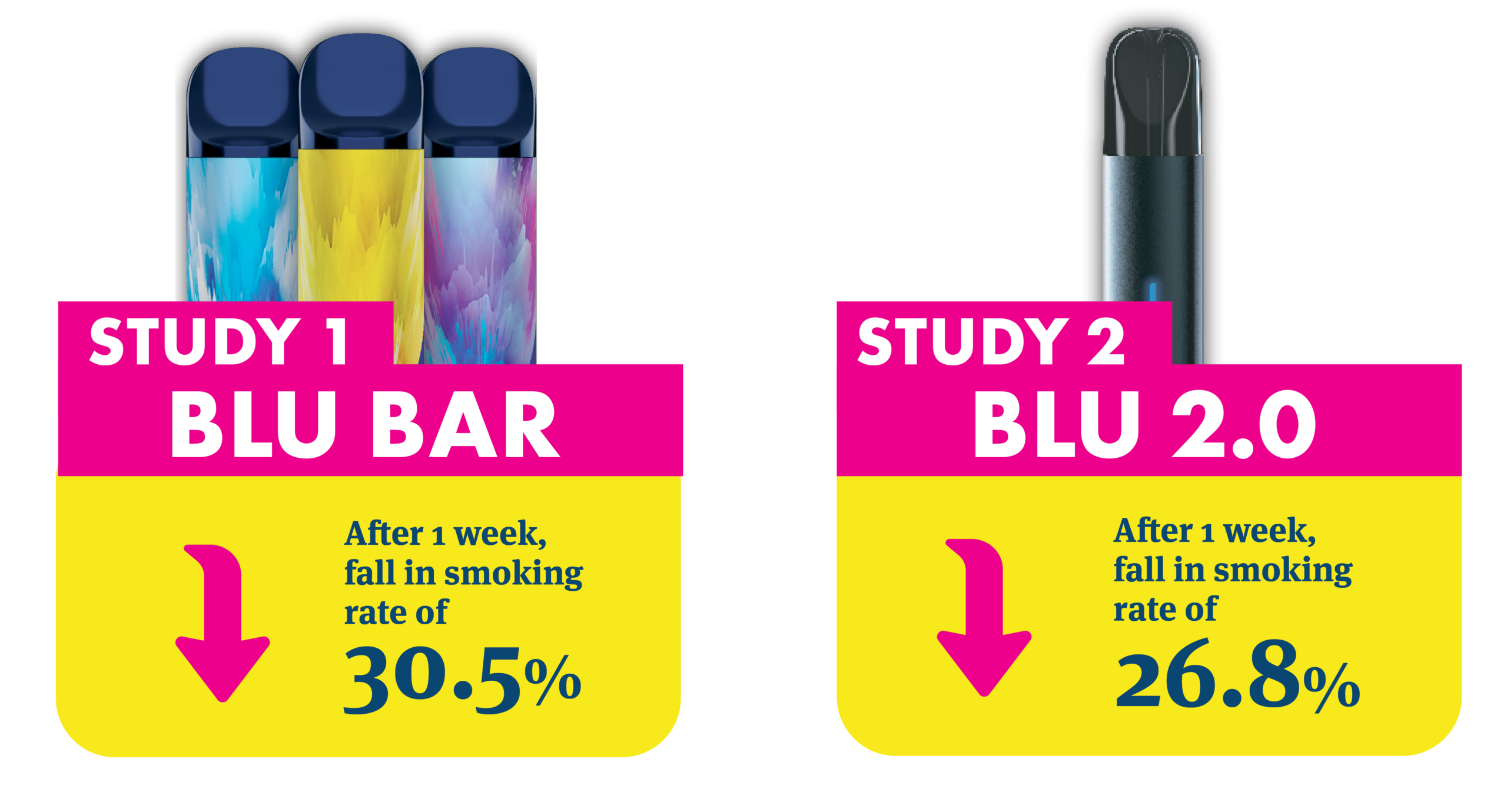

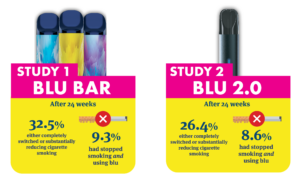
This strong start was sustained throughout the duration of the 6-week studies, and at 24-week follow-up.
In other words, vaping helped significant numbers of participants either substantially reduce their smoking, or even leave cigarettes/nicotine behind entirely.
 Flavours helped to drive substantial changes in smoking behaviour; as the diagram below shows they were exclusively used by all those participants who stopped smoking during the studies.
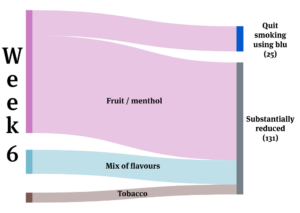
Please note the above illustrative data is from the blu 2.0-focused study only.
 A range of flavours was also key to supporting participants transitioning from smoking to vaping.
The diagram above also shows that non-fruit flavours like tobacco – or a mix of different flavours – also had an important role to play in some participants substantially reducing their smoking.
However, all those participants who stopped smoking entirely by the end of the studies did so exclusively using fruit and/or menthol flavours.
A wide range of responsibly manufactured and marketed flavours are therefore clearly important in helping drive and support positive changes in smoking behaviour.

Differing flavour preferences were observed within genders and across various age groups.
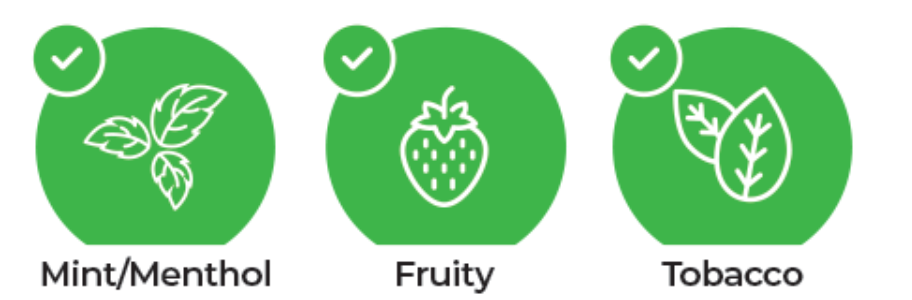
Focusing on gender, many male participants heavily flavoured Fresh Mint pods, while female participants generally opted for a wider variety of flavours.
Turning to ages, participants aged 19-24 consumed Fresh Mint pods most often. Those aged 25-44 liked Fresh Mint and Blueberry Ice, while participants aged between 45-64 saw an increase in Golden Tobacco use over time – while also reporting high usage of other flavours.
These findings continue to make the case that a wide range of quality, responsible flavours are crucial; they encourage trial – and support switching – across a broad range of demographics.
 Participants’ motivation to stop smoking increased as the study progressed.
Encouragingly, participants increasingly reported positive feelings like satisfaction, enjoyment, ease of use, and relief from smoking cravings as they vaped during the studies.
These responses coincided with an increasing motivation to transition to blu or stop smoking as the studies progressed.
For instance, focusing on the blu 2.0 study, 5.4% of smokers initially reported a strong desire in intention to stop smoking within the short to medium term. This figure more than doubled to 11.3% at week-2, and had quadrupled by Week-6 (21.3%) where it broadly remained stable until follow-up at week–24 – suggesting that in addition to those who completely switched to blu 2.0, another group of smokers in our study may have been highly motivated to transition to blu 2.0, or stop smoking, after the end of the 6 weeks.
 Tobacco harm reduction is not a myth, nor an ‘industry ploy’.
 Contrary to the stance of some public health bodies and regulators, our actual use studies provide more compelling evidence that NGP like vapes can potentially contribute to better public health outcomes.
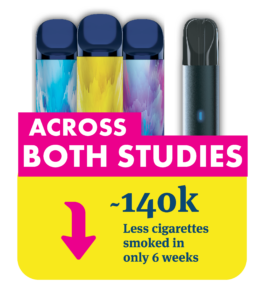
For instance, across both studies, participants smoked an estimated 140,000 fewer cigarettes in only 6 weeks.
Data is currently internal, but we’re planning to publish the full results of both blu actual-use studies in the peer-reviewed academic literature later this year.
Copy by Rob Taylor, Senior Harm Reduction Communications Manager.
Follow us on LinkedIn and read more about our intentions to help create potentially healthier futures for our consumers on our corporate website. You are free to share this content with credit to Imperial Brands under a Creative Commons Attribution-NoDerivatives 4.0 International (CC BY-ND 4.0) license.