 Debate – and even regulation – around flavoured vapes is often dominated by binary narratives built on emotions and ideologies rather than data. Our new peer-reviewed paper draws from over 230 published studies to help separate fact from feelings… and fiction.
Matt Stevenson, Scientific Substantiation Senior Manager and paper co-author, explores some of the review’s most important findings.
 Responsibly manufactured flavours don’t enhance toxicological or inhalation risks
A central concern often raised about flavoured vapes is whether flavour ingredients, like fruit and mint, result in additional inhalation risks compared with tobacco flavours.
Our review demonstrates there’s no robust scientific evidence that non-tobacco flavours – when properly formulated and tested – present any greater toxicological risk than tobacco flavours.
Most toxicology studies that report elevated risks appear to use unrealistic conditions, including excessive temperatures, over-concentrated flavouring agents, or direct chemical exposure, rather than aerosol generation that more accurately reflects real-world conditions.
When experiments are conducted under realistic device settings and puff topography, toxicological markers remain substantially lower than those observed with cigarette smoke.
Indeed, research like this study in Toxicity In Vitro shows significant reductions in cytotoxicity were observed for a range of flavoured vapes ranging from 143 to 1191 times less toxic than cigarettes, and no discernible genotoxic or mutagenic effects at all.
These findings firmly underscore the importance of context.
Inhalation safety depends not only on flavour compounds’ chemical identity, but, critically, also on product design, formulation, aerosol generation parameters, and realistic exposure conditions.
 Flavours aren’t the primary driver of vape dependence
Concerns that non-tobacco flavoured vapes might enhance nicotine dependence or abuse liability are widespread, albeit largely unfounded according to the scientific data in our review.
There’s no convincing evidence that sweet, fruity, or minty flavoured vapes increase dependence, relative to tobacco-flavoured ones.
Instead, nicotine remains the principal driver of dependence. Conflating flavour attractiveness with dependence overlooks the pharmacological realities, and risks undermining evidence-based regulation.
 Flavours support switching
One of the most significant regulatory and public health considerations relates to the role of flavoured vapes in helping adult individuals who smoke reduce their cigarette consumption[1].

Our review identifies consistent evidence that many adult smokers prefer non-tobacco flavours when switching, and this underpins sustained cigarette abstinence.
For example, this study on PubMed from Harm Reduction Journal looked at 69,233 adult vapers and found that the most prevalent flavour at the time of smoking cessation was fruit at over 83%.
It also found that tobacco-flavour use prevalence was low and further reduced over time, emphasising the role a range of flavours may play in long-term public health strategies.
Given that smoking remains a leading cause of preventable disease globally, maintaining vape flavour diversity may therefore potentially contribute substantially to reducing smoking prevalence.
 Scientific evidence should drive flavours regulation and policy
Bans on non-tobacco flavoured vapes may seem precautionary and are generally well-intentioned, but the scientific evidence shows they can have unintended negative consequences.
For example, evidence suggests such bans may reduce vaping’s appeal to adult smokers. This undermines switching and, in some states and countries, has increased cigarette smoking or illicit vape use.
From a regulatory-science perspective, a more balanced, evidence-based approach is needed — one that prioritises facts over feelings, encouraging data-driven decision making.
It should protect youth and unintended users, but preserve flavour diversity and enforce responsible product stewardship to better support adult smokers seeking a reduced-risk alternative.
Conclusions
Our literature review highlights that, when responsible formulation, realistic testing, and context-based risk assessment are applied, flavoured vapes can help drive meaningful public health benefits.
Nevertheless, the paper also underscores the need for continued research, including long-term inhalation studies, independent toxicological assessment, and rigorous real-world surveillance to continue to build the existing weight-of-evidence.
For scientific audiences, public health bodies, regulators and governments, the ultimate message is clear: scientific evidence should guide policy – not assumptions and feelings, and any accompanying myths and misconceptions should be firmly debunked through impactful public health communications.
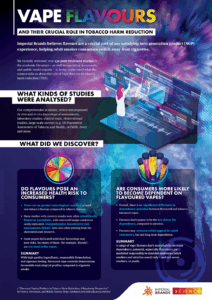
For more insight on what scientific evidence says about the relationship between flavoured vapes and THR, be sure to check out our infographic and read our literature review, Flavoured Vaping Products in Tobacco Harm Reduction: A Regulatory Perspective, in full here.
[1] Our vapes are not licensed cessation products, nor marketed as such.
Additional copy by Rob Taylor, Senior Harm Reduction Communications Manager.
Follow us on LinkedIn and read more about our intentions to help create potentially healthier futures for our consumers on our corporate website. You are free to share this content with credit to Imperial Brands under a Creative Commons Attribution-NoDerivatives 4.0 International (CC BY-ND 4.0) license.